Apple Watch Ships 21% More Units in Q1 2026, Outpacing Smartwatch Market Growth
Apple Watch shipments have surged ahead of the broader smartwatch segment in the first quarter of 2026, reflecting strong ongoing demand. This performance highlights Apple's resilience in a competitive landscape, according to a recent report from Counterpoint Research.
Strong Growth for Apple in Smartwatch Sector
Counterpoint's data reveals that while global smartwatch shipments grew by only 4% year-on-year, Apple achieved an impressive 21% increase, capturing a commanding 23% share of the market. This disparity is striking and indicates that Apple's strategy is resonating more effectively with consumers compared to other brands. In a market where many players are struggling to maintain footing, Apple's robust growth speaks volumes about its brand loyalty and product appeal.
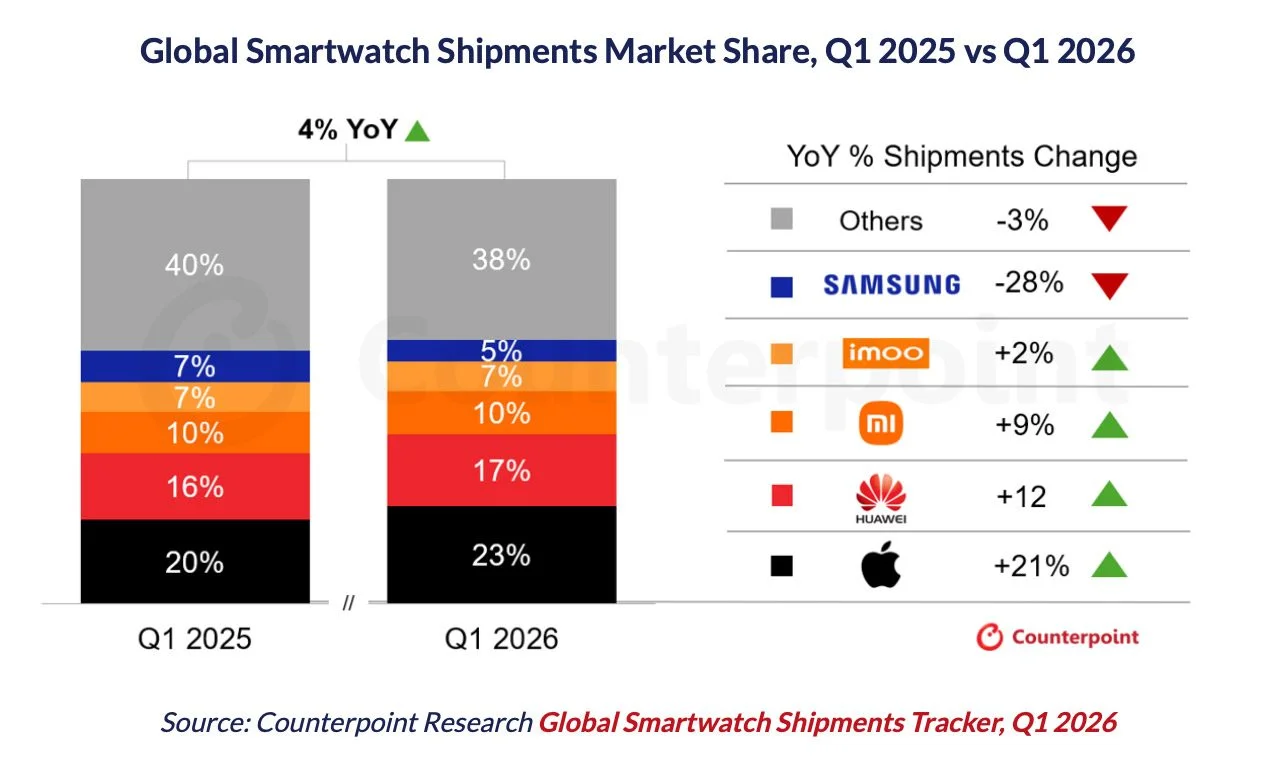
In contrast, Huawei secured the second position with a 12% rise in shipments, holding 17% of the global market. Xiaomi also posted a respectable 9% growth, showcasing its capability to retain customer interest with budget-friendly options. However, Samsung encountered significant challenges, seeing shipments fall by a staggering 28%, with its market share slipping further. This drop raises questions about Samsung's direction in the smartwatch segment. Are they overextending themselves or merely failing to innovate more aggressively?
Anshika Jain, Principal Analyst at Counterpoint, noted that North America accounted for over half of Apple’s shipments, while China and Europe registered the fastest growth rates for the brand. This regional insight illustrates how critical geography is to Apple's success – the company capitalizes on its market dominance where it’s most established. Nonetheless, the surprisingly strong show in China and Europe suggests untapped potential and may indicate a shift in consumer preferences. The success of the Apple Watch can be partly attributed to important health feature upgrades, which resonate deeply with health-conscious users. The attractive pricing of the new SE 3 model also plays a vital role, drawing in new customers who might be hesitant to invest in the flagship models.
Market Dynamics and Pricing Trends
Interestingly, the average selling price of smartwatches increased by 6% during this period, a change the report attributes to advancements in health monitoring capabilities. These tech leaps lead to increased consumer expectations. The growing demand for premium models in emerging markets, particularly India, is a sign that consumers are willing to spend more on quality products. That presents a conundrum for brands: lower-cost options may attract entry-level users, but the premium models cater to those looking for more features and better design.
This upward shift in average selling price is contrasted sharply with trends in other sectors, particularly smartphones. Counterpoint also suggested that, unlike the smartphone sector, where rising component costs have had a noticeable impact, smartwatches are less affected due to their relatively lower material costs. This detail is significant because it indicates a level of stability in the smartwatch market that isn't commonly found. If you're working in this space, focusing on health and wellness features might fuel growth, while keeping costs comparatively low can protect profit margins.
Another angle to consider is brand reputation. As companies like Apple continue to establish themselves as leaders in health technology, this could shift consumer perceptions about what a smartwatch should deliver. Health tracking, sleep monitoring, and fitness capabilities are becoming less of a luxury and more of an expectation, forcing brands to differentiate themselves rapidly.
Implications and Future Outlook
This analysis has more layers than it might first appear. Apple's impressive growth isn’t simply about better marketing or brand loyalty—it points toward an evolving consumer consciousness focused on health and wellness. The situation raises interesting questions about how competitive the smartwatch ecosystem can be. Will other brands pivot their strategies to meet this new demand? Or will they continue down the paths they’ve been following, perhaps risking irrelevance?
The impressive capture of the smartwatch market by Apple needs to be contextualized against broader tech trends. Consumers are increasingly integrating wearable technology into their lives, not just for fitness but for overall health management. The implications stretch beyond mere sales figures; this trend seems to signal that we might be entering a new era where wearables play an integral role in personal healthcare.
As new players emerge in this field, brands that offer unique, compelling features will likely thrive. And this is the part most people overlook: differentiation isn’t just about adding features; it’s about enhancing the user experience. If brands can’t deliver value beyond what consumers already expect, they may see their market positions slip away.
With health monitoring becoming a staple, brands like Apple are in a prime position to continue leading, but the pressure is on. They need to keep evolving as new technologies and customer preferences emerge. What this means for you is that staying informed about these changes could be pivotal, especially if you’re involved in product development, marketing, or sales in the consumer tech arena.
For a deeper look at the findings, check out the full report here.