Enhancing R Shiny with the Versatile shiny.webawesome UI Package
The newly introduced shiny.webawesome package significantly enhances the user interface of R Shiny applications by integrating the versatile Web Awesome framework. With this development, developers can generate reactive bindings, utilize a diverse library of UI components, and benefit from built-in layout utilities, all while maintaining close alignment with upstream Web Awesome documentation and examples.
As developers seek to create visually appealing and user-friendly applications, shiny.webawesome provides all the tools needed to craft cohesive interfaces that align with contemporary web standards. You can explore the package and access the documentation through its CRAN page, R-universe, and the official package website.
Identifying the Need
Recognizing a gap in Shiny's UI offerings, the creators of shiny.webawesome aimed to deliver a modern and polished component library. Web Awesome emerged as an optimal choice due to its comprehensive array of components, layout options, and design tokens. Moreover, its standards-based structure makes it accessible for R developers, ensuring that the package can effectively keep pace with Web Awesome's iterative updates.
A Functional Showcase
To demonstrate its capabilities, shiny.webawesome features a simple yet functional app example, showcasing its graphical assets and interface elements. You can check out the live application and its code in detail at: Live Example.
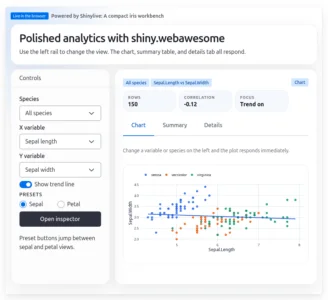
This example effectively captures a variety of functionalities through:
- A visually comprehensive collection of UI components
- Implementation of Web Awesome's layout utilities, like
wa-stackandwa-align-*classes - Advanced styling using Web Awesome's design tokens and classes including
--wa-color-*andwa-body-* - Reactive input binding tailored for Shiny compatibility
- Utility methods for manipulating HTML properties and executing lightweight JavaScript
Core Design Principles
The design philosophy behind shiny.webawesome centers around maintaining a close relationship with the upstream Web Awesome framework. Component wrappers are chiefly generated using Web Awesome metadata, which not only preserves naming conventions and structural integrity but also adapts components to meet R's syntax norms like snake_case.
This symbiotic relationship allows developers to refer to the upstream documentation when in search of detailed information about specific components, thereby promoting a more streamlined workflow. Currently, all Web Awesome components are supported, which ensures that the documentation becomes a practical reference throughout the development process.
In addition, the package introduces a lightweight set of page and layout helpers, along with selective reactive bindings, empowering developers to efficiently connect the client-server model inherent in Shiny applications.
Reactive Bindings in Shiny
When it comes to reactive bindings, shiny.webawesome takes a thoughtful approach. Instead of flooding Shiny with every possible browser event or telemetry detail, it opts for a curated selection of bindings that resonate with Shiny's reactive framework. This focus is on delivering significant state changes rather than capturing all low-level events.
In practice, each binding communicates a durable value: for instance, a select input reports its active selection, while a dialog indicates its status. This design strategy conveys the information that matters, reducing the noise from unnecessary event streams.
Furthermore, certain components, such as buttons, are delineated as actions rather than values, in line with Shiny’s event-driven model. For example, a button click generates a new input event, while other UI elements, like dropdowns, may require reactivity for every selection while still providing access to the most recently chosen option.
Command API for Advanced Interactions
While shiny.webawesome effectively covers numerous interaction patterns through component wrappers and bindings, there are instances where direct browser manipulation is necessary. In those situations, the package offers a narrow command API.
Key functions like wa_set_property() and wa_call_method() empower developers to send explicit commands to browser elements identified by unique id attributes. This command layer is ideal for scenarios needing a single, immediate action rather than an entire binding alteration.
Additionally, the package includes wa_js(), which serves the purpose of adding lightweight JavaScript code for local browser interactions. This ability is crucial for auxiliary functions, allowing Shiny developers to handle live events or update component states efficiently.
For a deeper dive into these capabilities, check the detailed articles on Shiny Bindings and Command API.
Final Thoughts
The shiny.webawesome package makes a notable contribution by integrating a sophisticated component library within Shiny, closely following Web Awesome's evolution. This alignment yields polished components combined with practical utility tools, ensuring that relevant upstream documentation is accessible throughout the development cycle.
For extensive examples, technical articles, and complete reference materials, visit the project’s homepage: shiny-webawesome.org.